
Guild meeting 5th May 2026 – Presentation by Tim Hurd

Tim, based in Wellington, New Zealand, is currently the National Carillonist of New Zealand at Ministry for Culture & Heritage. His experience includes previous roles at Olym
pic Carillon International, National Carillon, Canberra and The Episcopal Church at Yale, Yale University.
Tim studied (and continues to study) Traditional Keyboard & String Instrument at West Dean College [Edward james Foundation] in the UK. The making of these instruments has given him exceptionally fine woodworking skills, in additional to working with brass and other materials, and performance based skills, Music Education, Teaching, Coaching and more.
Tim came along with a selection of musical instruments he has made, spending time to explain how they were made, and challenges encountered.
1. Duduk - the national instrument of Armenia, a double-reed cylindrical bore flute. Usually made from apricot wood, but my example crafted in hard maple [Acer saccharum]. Used in many contemporary film scores owing to its thick double-reed, permitting microtonal pitch bending and expressive, wide vibrato effects.
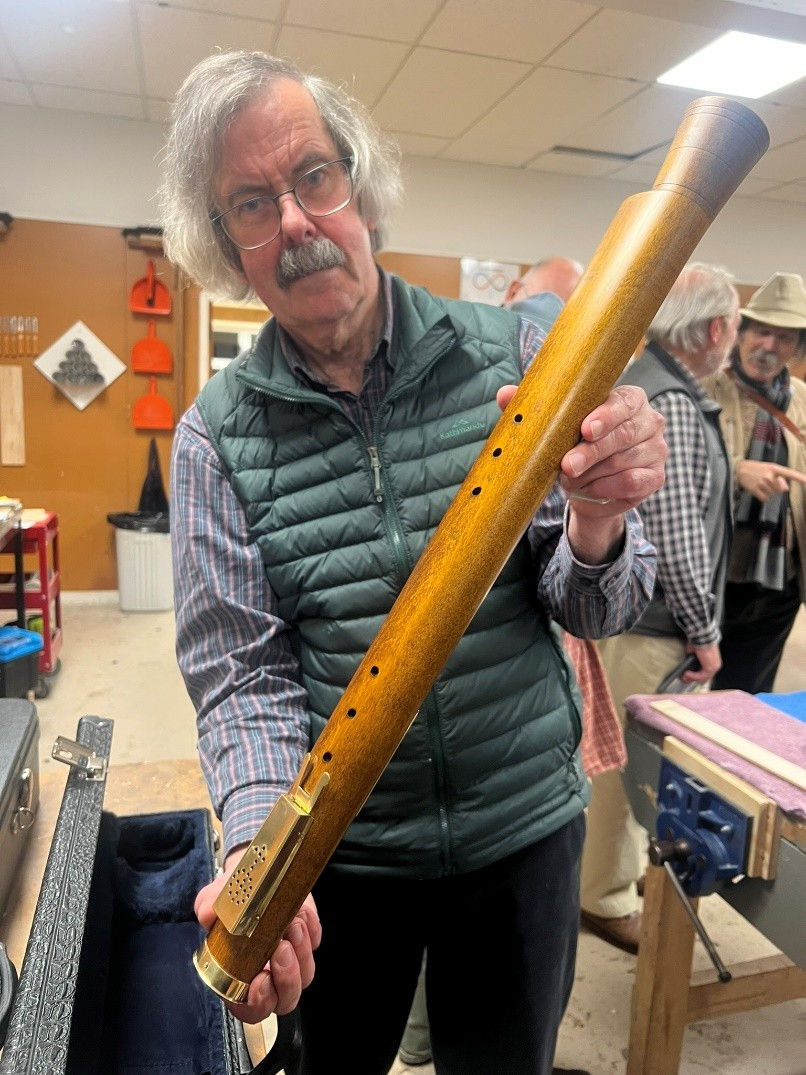
2. Tenor curtal [or dulciaan] - a late Renaissance proto-bassoon. Double-reed instrument used in mixed or ‘broken’ consorts, mainly 16-17th c.
Tim explained that there were 2 bores down the instrument, slightly tapered, and the finger holes are drilled at different angles to intersect the bores at precise points.

3. Bass racket [‘pocket bassoon’] - a compact, double-reed instrument used to reinforce ensemble harmonies with soft but distinct overtones, owing to narrow cylindrical bore design [9 interconnected tubes measuring approximately 1.2m in internal length].
4. Contrabass Rackett - an octave below the bass rackett, similar construction to bass.
Both of the above 2 instruments have 8 internal parallel bores drilled to compact the overall path the wind has to travel of 1.2m. Again the fingerholes are drilled at specific angles in order to facilitate the players handspan, and the holes need to line up precisely with one of the 8 bores.

5. Orpharion - late English Renaissance flat bodied wire-strung lute [flourished 1580-1630]. Nine double courses of brass & steel strings, 18 strings in all. Inspired by one of only two extant museum holdings, this the instrument by Francis Palmer, London 1617, currently in the Carl Claudius Samling, National Museum of Denmark. East Indian rosewood & quilted sycamore, with snakewood & ebony detailing and horse bone inlays. Sycamore string inlays were glued into thin EIR material ‘flat’, prior to bending. See FoMRHI article for details.

6. Work in progress - one of a pair of ‘pardessus de viole’ after Louis Guersan, Paris 1761. Figurehead for #1 instrument a carved rendition of a ‘paper nautilus’ [Argonauta hians]. 1st instrument in flamed maple with Brazilian rosewood detailing, the second in Rio rosewood with maple detailing = a salt & pepper’ matched pair, made to a single exemplar. Spruce top gouge-profiled to 2.2mm thickness, with ‘Flaming Sword of Islam’ tone holes. Final scraping finished off with sharkskin.

A final recommendation was to look at the film ‘MusicWood’ - about the significant environmental issues [including CITES interventions] around responsible material sourcing (in this case Sitka Spruce trees).


Comments